
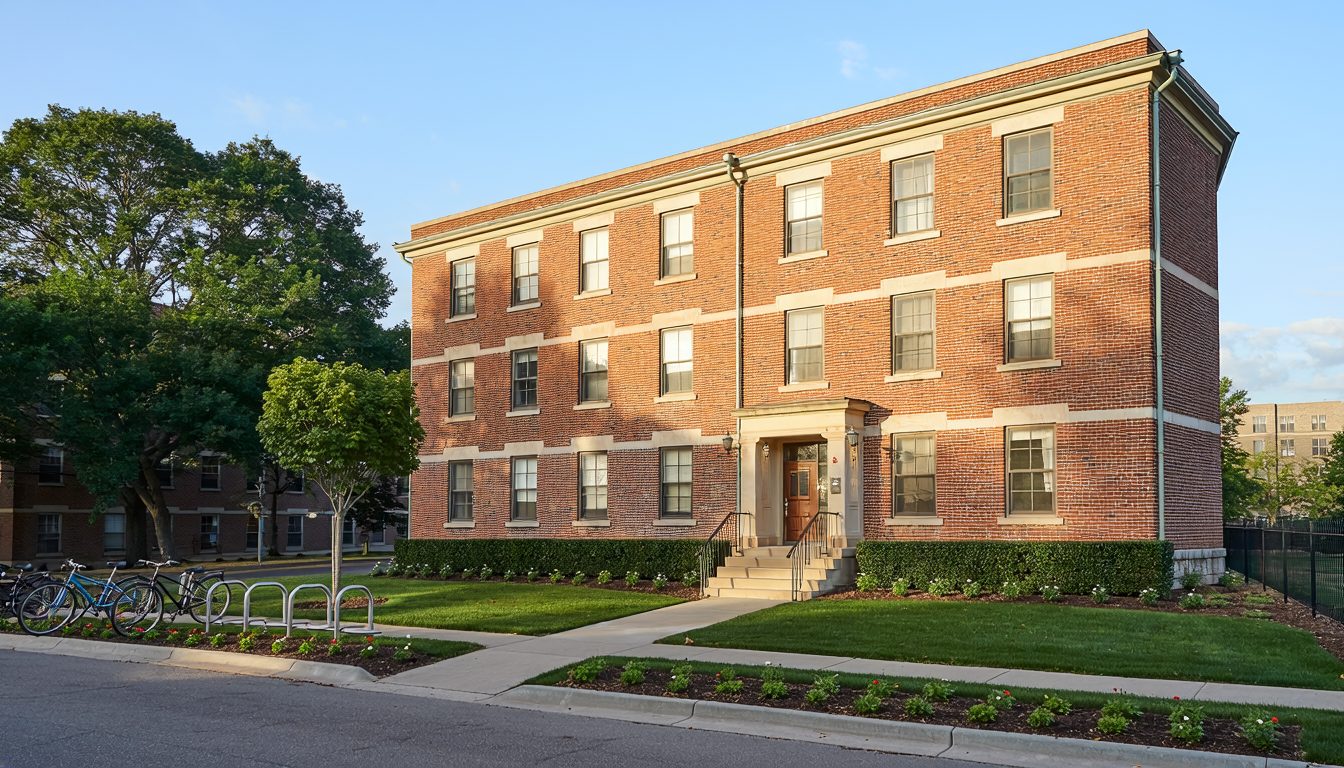
When a new purpose-built community opens near campus, owners of older student housing often assume they are at a permanent disadvantage. The new building has fresh finishes, modern amenities, and polished marketing. It is easy to conclude that age alone decides who wins.
Teddy Abdelmalek, SVP of Business Development at HH Red Stone, sees it differently. “Age by itself is not the problem,” he said. “Neglect is the problem.” His view is that the real drivers of performance in student housing property management are design, service, and execution, and older assets can still compete on two of the three.
Abdelmalek says purpose-built student housing often wins for reasons that go beyond being newer. “The entire product was designed around how students actually live,” he said.
That includes the unit mix, bedroom-to-bathroom ratios, furniture packages, amenity spaces, technology, security, the leasing model, and even the move-in process. When a building is designed around the student from day one, residents run into less friction and the management team needs fewer workarounds.
Older properties were often built for a different resident profile or a different era of student living. Abdelmalek points to common issues: awkward floor plans, too few bathrooms, limited outlets, weak Wi-Fi infrastructure, small common areas, inadequate package storage, and parking that does not match current demand. Purpose-built housing tends to solve those problems structurally, which makes it easier to lease.
Design is an advantage, but it is not the whole story. Abdelmalek says an older building that is clean, well maintained, well managed, and honestly positioned can outperform a newer property with poor service and weak execution.
Older assets tend to get into trouble when ownership tries to compete visually with new construction while ignoring maintenance, cleanliness, customer service, or basic functionality.
“Residents will forgive an older countertop,” he said. “They will not forgive a broken air conditioner, dirty hallway, or maintenance request that sits unanswered for five days.”
For owners, this changes the question. Instead of asking how to look as new as the competition, the better question is whether the property works reliably every day.
According to Abdelmalek, service, location, culture, and value are where an older property can compete and win.
“A resident who feels known, receives quick responses, and sees a team that cares about the property can have a much better experience in an older building than in a brand-new community where they feel anonymous,” he said.
Older properties also often have physical advantages of their own. Many sit in established locations with better walkability, and some offer larger floor plans than newer buildings. When those strengths are paired with strong operations, Abdelmalek sees no reason an older asset cannot compete effectively.
The first impression often decides more than the amenity list. Abdelmalek says residents and parents notice whether a property feels cared for, and that judgment forms before they ever see the model unit.
They notice the landscaping, the signage, the parking lot, the smell of the lobby, the cleanliness of the hallways, and whether the person at the front desk looks up and acknowledges them. Parents may ask about security and students may ask about amenities, but both are evaluating whether the property feels organized, safe, and professionally managed.
“The first five minutes often tell them more than the amenity package,” he said.
For owners of older assets, this is encouraging. Many of the factors that shape a prospect’s first impression are within reach without major construction. The gap between an older property and a new competitor is often less about the building and more about how it is run. Owners can view the range of properties in HH Red Stone’s portfolio.
HH Red Stone is the property management arm of HH Group, managing approximately 10,000 beds across multiple asset classes including student housing, multifamily, affordable, and mixed-use properties nationwide. After a decade of exclusively managing HH Group’s owned portfolio, the company launched its third-party management vertical to serve other owners with the same institutional-grade approach it applies to its own assets. HH Red Stone’s operating philosophy centers on “functional hospitality,” treating residents as CEOs and maintaining operations with the discipline and consistency that drives sustainable success. Website: www.hhredstone.com
This article is based on information provided by the expert source cited above. It is intended for general informational purposes only and does not constitute legal, financial, or real estate advice. Readers should conduct their own research and consult qualified professionals before making any real estate or financial decisions.
Disclosure: Individuals or companies mentioned may have a commercial relationship with KeyCrew.


Comments
No comments on this item Please log in to comment by clicking here